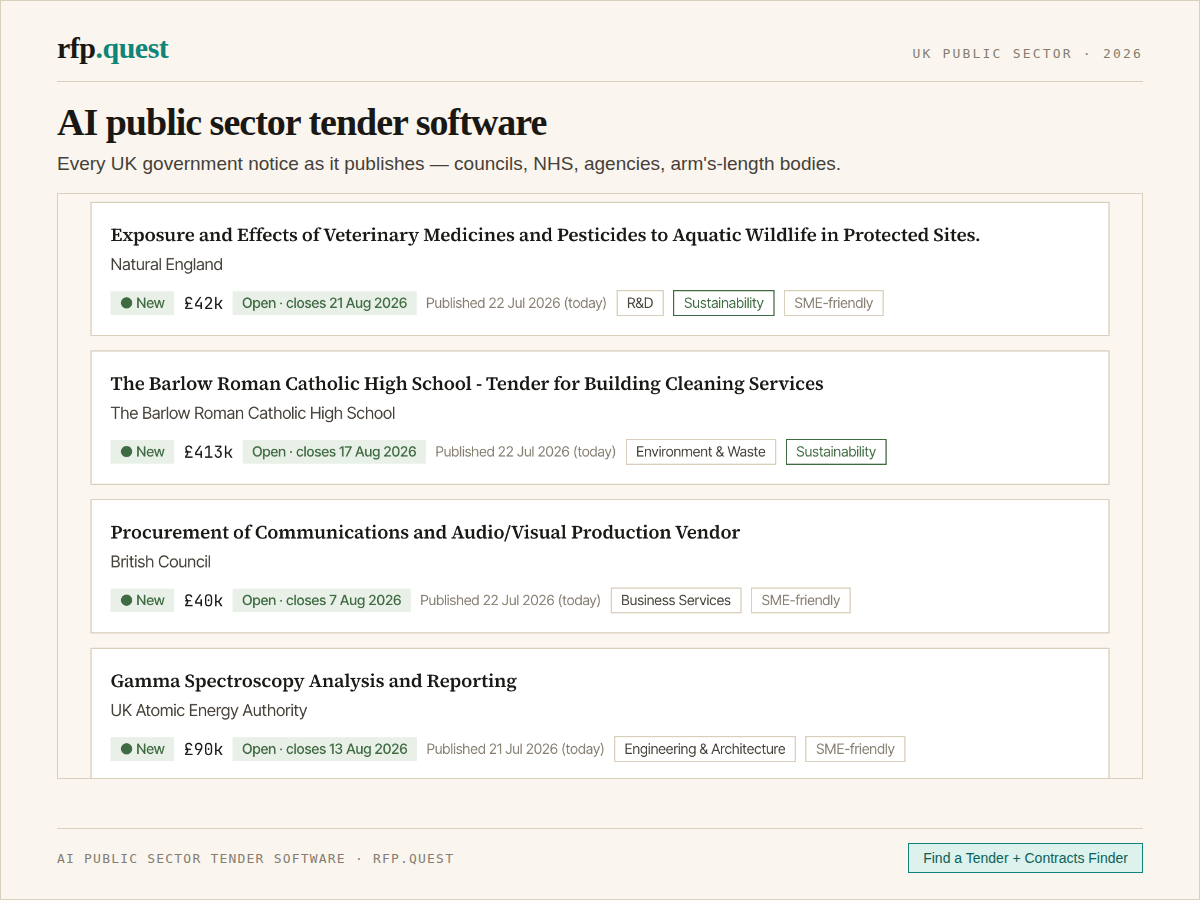
What Is AI Public Sector Tender Software?
AI public sector tender software applies large language models to the specific machinery of UK government procurement: structured notice formats on the Central Digital Platform, Procurement Act 2023 evaluation frameworks, mandated social value weightings, and sector-specific certification gates.
That is a narrower definition than most vendors use, and deliberately so. A tool that reformats your existing proposal library into a nicer document is proposal software. AI public sector tender software is something else: it has to know that a Most Advantageous Tender award is scored differently from the old MEAT test, that a conditions-of-participation failure is fatal regardless of how good the method statement is, and that a clinical NHS service is not procured under the same Act as an NHS laptop refresh.
How It Differs From Generic Proposal Tools
Generic AI proposal tools optimise for one thing: producing plausible prose quickly. That is genuinely useful, and it is roughly a third of the job. The other two thirds are regime knowledge and evidence control.
| Capability | Generic AI proposal tool | AI public sector tender software |
|---|---|---|
| Drafts long-form answers from a content library | Yes | Yes |
| Ingests structured UK notice data automatically | No | Yes |
| Distinguishes pass/fail gates from scored criteria | No | Yes |
| Knows the current UK procurement thresholds | No | Yes |
| Applies the published Social Value Model | No | Yes |
| Tracks certification expiry against tender requirements | Rarely | Yes |
| Knows which Act or regime a notice falls under | No | Yes |
The Five Jobs It Has to Do
Every credible product in this category is doing some version of these five things. Put another way, the category is only as good as the weakest of the five. When you evaluate vendors, evaluate them job by job rather than by feature count.
- Ingest. Pull every relevant notice from the portals that publish UK public contracts, in something better than a keyword email alert.
- Match. Score each notice against what your organisation can actually deliver and actually evidence — not against a list of search terms.
- Qualify. Surface the reasons not to bid early enough to save the bid team's week.
- Draft. Produce a first response that follows the evaluation criteria in the order the evaluator will read them.
- Evidence. Hold the certifications, policies, case studies and financials, and flag when a tender asks for one you do not have.
The UK Public Sector Opportunity in 2026
Gross UK public sector procurement spending reached £461 billion in 2025/26, up around £23 billion — roughly 5% — on the previous year, according to the House of Commons Library's procurement statistics briefing drawing on HM Treasury's Public Expenditure Statistical Analyses 2026.
Within that, the National Audit Office estimates public bodies spend around £125 billion a year on common goods and services alone — the category most SME suppliers are actually competing in.
Where the SME Money Is Going
In March 2026 the government set departmental SME spending targets expected to direct over £7.4 billion a year to small businesses by 2028. Departmental targets vary widely — DSIT at 40%, DCMS at 33%, Cabinet Office at 30% — with the detail set out in the Cabinet Office and HM Treasury SME Action Plan 2025 to 2028.
The National Procurement Policy Statement, in effect since 24 February 2025, sets three strategic priorities for contracting authorities: driving economic growth, delivering social and economic value, and building commercial capability. It explicitly directs authorities to maximise spend with SMEs and voluntary, community and social enterprises.
The policy tailwind is real, and it is the commercial case for AI public sector tender software. The constraint is capacity: a ten-person supplier cannot read every notice, and the notices that matter are not the ones with the obvious keywords in the title. That capacity gap is the entire reason this category exists.
AI Public Sector Tender Software for Every UK Procurement Portal
UK public contracts are published across several portals with different legal bases. Devolved procurement is a genuinely separate regime, not a regional variation — Scotland operates under the Procurement Reform (Scotland) Act 2014, not the Procurement Act 2023.
| Portal | Coverage | Legal basis |
|---|---|---|
| Find a Tender | England, Wales, NI — above and below threshold since 24 Feb 2025 | Procurement Act 2023 |
| Contracts Finder | England — opportunities and awards, archive from Feb 2015 | Legacy + PA23 transition |
| Public Contracts Scotland | All Scottish public bodies, regulated procurements | Procurement Reform (Scotland) Act 2014 |
| Sell2Wales | Welsh public bodies, 1,200+ buyer profiles | Welsh regime |
| eTendersNI | NI departments, agencies and arms-length bodies | NI regime |
| Government Commercial Agency | Central frameworks including G-Cloud | Framework agreements |
Find a Tender is now the single most important of these. Since 24 February 2025 it hosts both above- and below-threshold notices across the full contract lifecycle — pipeline, planned, tender, award, contract details, performance and termination — and it now also carries a Payments Transparency Register. Software that monitors only above-threshold notices misses most of the addressable market for a small supplier.
What RFP Quest Actually Covers
RFP Quest ingests Find a Tender and Contracts Finder in real time. It does not ingest the other four. Public Contracts Scotland, Sell2Wales, eTendersNI and the ProContract regional instances are on the roadmap and are not in the product today.
We publish that because the alternative — implying seven-portal coverage and letting you find out later — is how this category earned its reputation.
Procurement Act 2023: What Changed in 2026
The Procurement Act 2023 went live on 24 February 2025, but it did not commence all at once. The Procurement Act 2023 (Commencement No. 4) Regulations 2025 brought three further sections into force across 2026, and any tender software you buy this year needs to reflect them. GOV.UK maintains a consolidated summary of the new legislative requirements.
From 1 January 2026: Contract Performance Notices
Section 71 commenced. Contracting authorities must now publish contract performance notices assessing supplier performance against published KPIs for contracts above £5 million, and this applies to public contracts generally, including call-offs from frameworks.
For suppliers this is a two-sided change. Your own delivery performance becomes a public record. So does your competitors'. An incumbent with a published poor-performance assessment is a materially weaker incumbent at re-tender, and that is now discoverable data rather than market gossip.
From 1 April 2026: Payment Transparency and the Unique Identifier
Section 70 commenced. Authorities must publish payments over £30,000 including VAT under contracts procured on or after 1 April 2026, quarterly, with the first period running to 30 June 2026.
At the same date, authorities must obtain a Central Digital Platform unique identifier from suppliers awarded notifiable below-threshold contracts and publish it in the contract details notice. techUK's supplier briefing makes the crucial clarification: registration is not a condition of bidding. It is a condition of award. If you have already registered, you do not need to register again.
The official guidance on the Central Digital Platform covers the authority-side obligation; the three-step supplier registration guide covers yours. Law firm analysis from Browne Jacobson and Hogan Lovells sets out the compliance mechanics in more depth.
Most Advantageous Tender: What It Changes for Drafting
The Act replaced Most Economically Advantageous Tender with Most Advantageous Tender. The word that left was "economically", and its departure is the point: authorities can weight social value, innovation and sustainability more heavily without justifying the departure from lowest-cost logic.
For AI public sector tender software this is a drafting instruction, not a trivia item. The software should read the published award criteria and their weightings, then allocate draft length and evidence density in proportion to the marks available — not in proportion to how much content the library happens to hold on each topic. Most losing bids are long where the marks are thin.
Debarment: A Risk Signal Worth Ingesting
The Debarment Review Service publishes a central debarment list of suppliers excluded or excludable from public procurement. Per the official debarment guidance, where a supplier is listed on a mandatory ground authorities must not allow them to bid; on a discretionary ground authorities may permit a bid after due diligence. Listings typically last up to five years.
This matters two ways: check yourself and your supply chain before you bid, and check the list before you assume an incumbent will be back.
2026 Procurement Thresholds Your Software Must Know
Thresholds changed on 1 January 2026 and hold until 31 December 2027. They are inclusive of VAT, which is the detail most stale content gets wrong. The authoritative table is the Cabinet Office thresholds guidance.
| Procurement type | Threshold (incl. VAT) |
|---|---|
| Central government — goods and services | £135,018 |
| Sub-central — goods and services | £207,720 |
| Works | £5,193,000 |
| Light touch — other contracts | £663,540 |
| Light touch — utilities | £884,720 |
| Light touch — concessions | £5,372,609 |
| Concessions | £5,193,000 |
| Utilities — non-works | £415,440 |
| Defence and security — goods and services | £415,440 |
Thresholds are the cheapest possible test of whether a vendor is maintaining its product. Any tool still quoting £139,688 as the central government threshold is running on 2024 data, and that is a reasonable first question to ask a vendor.
NHS Procurement Is a Different Regime
NHS procurement is where generic tools most reliably mislead, because two different regimes run side by side.
The Provider Selection Regime Is Not the Procurement Act
Clinical health care services are procured under the Health Care Services (Provider Selection Regime) Regulations 2023, in force since 1 January 2024, with statutory guidance from NHS England. PSR runs its own processes — Direct Award A, B and C, the Most Suitable Provider Process, and the Competitive Process — with services in scope defined by CPV code.
Non-clinical NHS spend — IT systems, estates, facilities management, professional services, equipment — sits under the Procurement Act 2023 and behaves like any other public contract.
The practical consequence: AI public sector tender software must classify the regime before it advises on process, because the timelines, the standstill mechanics and the challenge routes all differ. Software that treats an ICB clinical services notice like a council IT tender will be wrong about the deadline.
NHS England: What Is Actually Happening
You will read a lot of confident content asserting that NHS England has been abolished and procurement has devolved to individual Trusts. As of August 2026 that is not accurate.
The Health Bill 2026-27, introduced on 14 May 2026, would abolish NHS England and transfer its functions to the Department of Health and Social Care, Integrated Care Boards or the Secretary of State. Per the House of Commons Library briefing, it remains before Parliament. Plan for the change; do not bid as though it has already happened.
Cyber Essentials and ISO 27001 in NHS Contracts
PPN 014 requires in-scope organisations — including NHS bodies — to require Cyber Essentials or Cyber Essentials Plus where suppliers handle citizens' personal information, government employee data, or ICT systems processing data at OFFICIAL. The NCSC's Cyber Essentials overview sets out the five technical controls and the two certification levels.
Notably, PPN 014 explicitly warns against blanket application. If a buyer has demanded Cyber Essentials Plus for a contract with no data processing, that is a clarification question worth asking, not a gate to accept silently.
Local Council Procurement
Local authorities are the highest-volume, lowest-visibility part of the UK market. They publish constantly, at values a small supplier can win, on portals that reward monitoring over relationships.
Social Value: PPN 002 and the 10% Minimum
The Public Services (Social Value) Act 2012 requires relevant authorities to consider how a procurement might improve economic, social and environmental well-being. PPN 002, which replaced PPN 06/20 in the February 2025 renumbering, goes considerably further: it mandates a minimum social value weighting of 10% of the total scores available for in-scope central government contracts.
The Social Value Model organises eight outcomes under the government's missions — fair work, skills for growth, resilient supply chains, sustainable procurement, community cohesion, employment for disadvantaged groups, pipeline development, and health and wellbeing.
This is the section where AI public sector tender software earns its keep fastest. The model is published, the outcomes are enumerated, the weighting floor is fixed, and most suppliers write the same generic paragraph about apprenticeships every time. Software that maps your actual commitments — local hiring numbers, apprenticeship starts, supply chain spend by postcode — to the specific outcome the buyer has selected will outscore a human writing at speed.
The Other Gates Your Software Should Flag
- Cyber Essentials where personal data is in scope, per PPN 014.
- GDPR and data processing evidence for any software or data contract.
- Environmental credentials — note that ISO 14001:2026 superseded the 2015 edition on 15 April 2026. Copy still citing ISO 14001:2015 is out of date.
- Net zero commitments, increasingly requested at contract values well below threshold.
Central Government, Frameworks and G-Cloud
Framework procurement has its own rhythm: you win a place, then you win call-offs, and the two need different content. AI public sector tender software should treat a framework application and a call-off mini-competition as separate document types, because buyers do.
The body that runs most central frameworks changed name this year. Crown Commercial Service became the Government Commercial Agency on 1 April 2026, merging CCS with several Cabinet Office central commercial teams. Links and content still pointing at crowncommercial.gov.uk redirect, but the naming matters in a bid.
For cloud and digital suppliers, the current live agreement is G-Cloud 14 (RM1557.14), which runs to 28 October 2026 following a six-month extension, with call-offs of up to 36 months plus a 12-month extension. Its successor, G-Cloud 15, reached contract award notice on 24 July 2026. At the time of writing the Government Commercial Agency has not published G-Cloud 15 call-off start dates, so treat any content claiming a firm go-live as speculation.
How AI Public Sector Tender Software Actually Drafts a Response
Vendors describe this as one step. It is six, and the quality of the output depends almost entirely on the first three — the ones nobody demos.
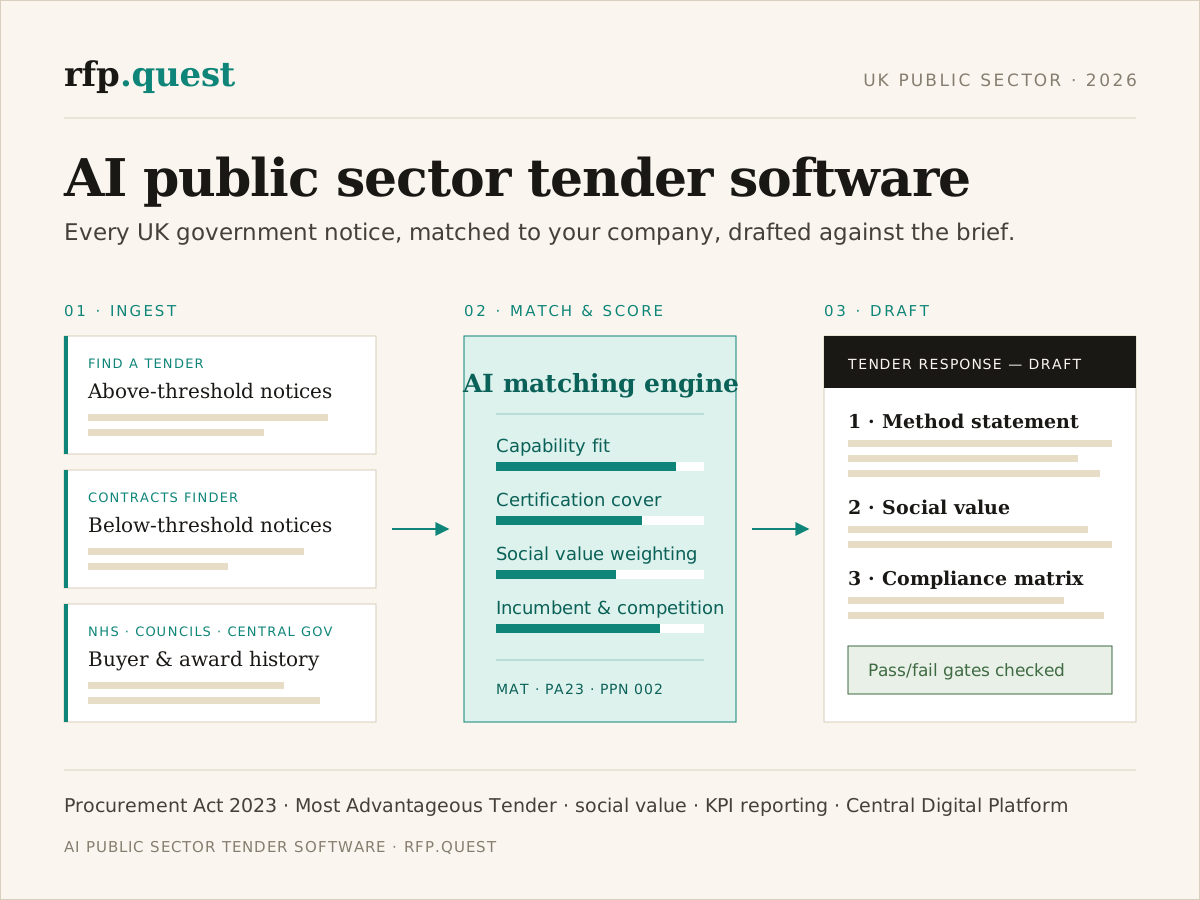
How AI public sector tender software moves a notice from ingest to a scored, drafted response.
- Parse the notice and the tender pack. Extract award criteria, weightings, conditions of participation, word limits, submission deadline and clarification deadline. Word limits in particular are a scoring mechanic, not a formatting preference.
- Build the compliance matrix. Every mandatory requirement, mapped to the evidence that satisfies it, with gaps flagged as gaps rather than filled with plausible text.
- Decide whether to bid. Cost of bid against realistic probability, incumbent presence, and whether any pass/fail gate is currently unmet. This is where the software saves the most money, and it saves it by producing a "no".
- Draft to the criteria. One response section per scored criterion, length allocated by marks available, evidence attached inline.
- Draft social value against the published model, mapped to the specific outcomes the buyer selected.
- Review and fact-check. Every number, reference and certification checked against the source before a human signs the declaration.
What It Cannot Do
An honest capability boundary is more useful than a feature list. There are five things AI public sector tender software genuinely cannot do, and a vendor who will name them is a vendor worth talking to.
It cannot invent evidence. If you do not hold ISO 27001, no amount of drafting quality substitutes for the certificate, and asserting otherwise in a submission is a false declaration.
It cannot know the buyer. The unwritten context — the failed previous contract, the councillor's priority, the incumbent's reputation inside the client — is not in the notice and is not in the model.
It cannot reliably price. Commercial strategy in public procurement is a judgement about your own cost base and appetite. Software can tell you what the winning price was last time, where the award data exists. It cannot tell you what yours should be.
It cannot make a weak offer strong. Automating the response to tenders you were never going to win produces more losses per week, not fewer.
And it should not be trusted on facts without a check. The ONS reports that AI use among UK businesses with 10 or more employees has almost tripled since late 2023, from around 12% to around 35% — but the average adopter uses barely more AI technologies than before, which the ONS reads as evidence of limited transformative impact so far. Adoption is not the same as advantage.
Certifications Worth Tracking
| Certification | Typically required for | Current edition |
|---|---|---|
| ISO 9001 | NHS and local authority tenders | 2015; 6th edition due Sept 2026 |
| ISO/IEC 27001 | All IT and data contracts | 2022 (Amd 1:2024) |
| ISO 14001 | Environmental and works contracts | 2026 — 2015 withdrawn |
| ISO/IEC 42001 | Emerging requirement for AI suppliers | 2023 |
| Cyber Essentials | Any contract handling personal data | Current scheme |
| Cyber Essentials Plus | Higher-risk ICT contracts | Current scheme |
| Constructionline | Construction sector public tenders | Tiered |
| SafeContractor / CHAS | Facilities management tenders | Current |
Expiry is the failure mode, not absence. A certificate that lapses three weeks before a submission deadline is functionally the same as never having held it — which is why tracking expiry dates against your live pipeline is a core function rather than an add-on.
Using AI Responsibly in Public Sector Bids
Buyers are working out their own position on AI at the same time as you are. The AI Playbook for the UK Government, updated in July 2026, sets ten principles civil servants must uphold when using AI — including meaningful human control at the right stages, and lawful, ethical and responsible use. Reading it tells you what your buyer has been trained to expect.
Three practical rules follow for suppliers:
Disclose when asked, accurately. A growing number of tender packs include an AI usage question. Answering it straightforwardly costs nothing; being caught understating it costs the contract.
Never let a model assert a fact you have not checked. This is the single largest risk in AI-drafted bids. A hallucinated case study or an invented reference is a false declaration, and the consequences run to debarment.
Consider ISO/IEC 42001 if you sell AI into the public sector. ISO/IEC 42001:2023 is the first AI management system standard and is appearing in tender specifications with increasing frequency.
Choosing AI Public Sector Tender Software: A Buyer's Checklist
Ten questions that separate the category from the marketing. Ask them in this order.
- Which portals do you ingest, in real time, today — not on the roadmap?
- Do you cover below-threshold notices on Find a Tender, or only above?
- What is the central government threshold from 1 January 2026? (£135,018 including VAT. A wrong answer tells you when the product was last updated.)
- Do you distinguish Provider Selection Regime notices from Procurement Act notices?
- How do you handle conditions of participation and pass/fail gates?
- Do you draft social value against the published Social Value Model, or generically?
- Do you track certification expiry against live opportunities?
- Do you surface reasons not to bid, or only reasons to bid?
- Where do the facts in a draft come from, and can each be traced to a source?
- What happens to my bid library and company data if I leave?
Question 8 is the one that separates a bid tool from a bid strategy tool. Anything that only ever encourages you to bid is optimising for your engagement, not your win rate.
Getting Started
AI public sector tender software is a force multiplier on a process, not a substitute for having one. If you are new to UK public procurement, the sequence that works is unglamorous: register on the Central Digital Platform via Find a Tender before you need to, get Cyber Essentials before a tender demands it, and monitor notices for a full quarter before you bid on anything — so that your first bid is a considered choice rather than the first opportunity you happened to notice.
RFP Quest is in early access. The tender feed and matching are free to start: get matched, or browse live tenders first if you would rather see the data before you register.
Related reading: AI bid management software · AI tool for bids and tenders · RFP tender terminology · Procurement Act 2023 guide · Government tender software · NHS tender software · Find a Tender integration · Contracts Finder · Social value procurement · UK tender certifications