RFP tender: what the phrase means, and which rules actually apply
An RFP asks you to propose a solution. A tender asks you to bid against a specification someone else has already written. The phrase RFP tender is what people say when they are not sure which of the two they have got.
And there is a fact that settles it faster than any definition: the words “RFP” and “request for proposal” do not appear anywhere in the Procurement Act 2023. UK law has tenders.
RFP or tender: the short answer
A request for proposal is issued when the buyer knows the outcome it wants but not the method, and invites you to supply the method. A tender is issued when the buyer has already fixed the specification, and invites you to bid against it.
That is the substantive difference, and it is not our formulation. The World Bank draws exactly this line between its two competitive methods: a Request for Proposals “should be used when… the Borrower’s business needs are better met by allowing Proposers to offer customized solutions,” while a Request for Bids “should be used when… the Borrower is able to specify detailed requirements to which Bidders respond”. The first is “normally conducted in a multi-stage process”; the second “in a single-stage process”. [21]
The complication is that in the UK the two words describe practice, not law. Which rules bind you is decided by who the buyer is and what the contract is worth — never by the title on the front of the document.
RFP tender meaning: the phrase, taken literally
“RFP tender” is not a document type, and no UK rulebook defines it. It is two names for two different things, said together — and people say them together because UK buyers use both words for the same pack of paper.
If you need one sentence: the RFP tender meaning that fits nearly every use of the phrase is a buyer's document pack asking you to submit a priced response that will be scored. Whether that pack is legally a tender depends on who sent it, not on what it is called.
The government's own commercial agency makes the collapse explicit. Its glossary entry for request for proposal says an RFP “is sometimes known as either Invitation to Tender (ITT), a Request for Quotation (RFQ) or a Request for Tender (RFT)” — four names for one stage, from the body that writes central government's commercial guidance. [19]
Everything after this point is about telling the two apart when it matters. If the word you keep meeting is the buyer's rather than the statute's, RFP procurement and what “RFP” means in a UK context take that vocabulary on its own terms.
The word “RFP” does not appear in UK procurement law
Every guide to this subject explains that a tender is “more formal”. Almost none of them mention the simplest test available: search the statute.
The Procurement Act 2023 has governed UK public procurement since 24 February 2025, when it replaced the Public Contracts Regulations 2015 and three sibling instruments. [13] [14] Its in-document search on legislation.gov.uk lets anyone check which words it actually uses. Run it and the result is unambiguous.
Method, stated so it can be re-run: legislation.gov.uk's in-document search (/ukpga/2023/54/contents?text=…) marks each matching provision. The banner appears whether or not there are matches, so the banner alone proves nothing — the counts above were taken from the match markers, with standstill as a positive control and a nonsense string as a negative control. Run 15 August 2026. [1]
The difference between a tender and an RFP, line by line
Eight dimensions, each stated as something you can check in the document in front of you rather than as an adjective. On a phone this reads as eight stacked cards, because a nine-column table on a 390px screen is a table nobody reads.
Two things worth saying plainly. First, the right-hand column describes a UK public-sector tender; a private company running something it calls a tender owes you none of it. Second, the left-hand column describes an RFP as the term is used in practice — because, as the section above establishes, there is no UK legal definition to describe instead.
RFP, RFQ, ITT, RFI, EOI: every acronym, decoded
Each card gives the full form, who actually defines it, and what it changes. Where a term has no authoritative definition, the card says so rather than inventing one.
Request for Proposal
Defined by: the US Federal Acquisition Regulation, which is where the term comes from. FAR 15.203: RFPs “are used in negotiated acquisitions to communicate Government requirements to prospective contractors and to solicit proposals.” [23]
In the UK: no statutory definition. The Government Commercial Agency's own glossary defines it and adds that it “is sometimes known as either Invitation to Tender (ITT), a Request for Quotation (RFQ) or a Request for Tender (RFT).” [19]
Invitation to Tender
Defined by: the Government Commercial Agency — “a formal request sent out by an organisation seeking bids from suppliers to provide goods or services.” [19]
Under the Act: Cabinet Office guidance is explicit that “in the case of the open procedure, the tender notice is the ‘invitation to tender’ as it invites all interested suppliers to submit a tender.” The ITT is not a separate statutory document. [16]
Request for Quotation
Defined by: UNCITRAL, whose Model Law reserves it for “readily available goods or services that are not specially produced… and for which there is an established market”, below a set threshold, with quotations sought from “at least three” suppliers. [20]
The legal catch: in US federal law a quotation is not an offer and “cannot be accepted by the Government to form a binding contract.” [25] A tender or a proposal, once accepted, can be.
Request for Information
Defined by: the Government Commercial Agency, which calls it “getting input from the marketplace in the form of a written report” and equates it with early market engagement. [19]
The statutory equivalent is preliminary market engagement under s.16 — and if a buyer does it, s.17 requires a preliminary market engagement notice before the tender notice, or reasons for not publishing one. Cabinet Office guidance on it never uses the phrase “RFI”. [10]
Expression of Interest
Defined by: the Government Commercial Agency — “a set of high level requirements outlined by the buyer and sent to potential suppliers”, usable for pre-market engagement or to build a shortlist. [19]
Under the Act the equivalent act is a request to participate: a supplier registering interest in response to a tender notice, where the authority intends to limit who is invited to tender. [16]
Selection Questionnaire
Status: retired. PPN 08/16 replaced the PQQ with the SQ in 2016. The SQ's own PPN — 03/24 — now sits under GOV.UK's “Public Contract Regulations 2015 PPNs” heading, which applies only to procurements commenced before 24 February 2025. [18]
What replaced it: conditions of participation under s.22. Cabinet Office guidance says the Act “does not prescribe how suppliers should demonstrate that they meet the conditions of participation, unlike regulation 59 of the PCR”. There is no national standard form any more. [17]
Request for Bids
Defined by: the World Bank, as one of four approved selection methods alongside RFP, RFQ and Direct Selection. RFB is for when the borrower “is able to specify detailed requirements to which Bidders respond”, single-stage. [21]
Read it as the World Bank's word for what the UK calls a tender. It replaced the older “Invitation for Bids / ICB” language when the 2016 Procurement Framework came in.
Invitation to Bid
No authoritative definition found. We looked in the Procurement Act 2023, UNCITRAL, the WTO GPA, the World Bank framework and UK guidance. The FAR uses “invitation for bids” for sealed bidding; NATO procurement guidance published by the Department for Business and Trade uses “Invitation for Bid (IFB)” without defining it. [24]
Treat ITB as commercial usage, not a defined term. If you receive one, the questions on this page still decide what it is.
Request for Tender
Defined by: nobody in UK law — it appears in the Government Commercial Agency glossary only as one of the alternative names for an RFP. [19]
Where you will meet it: Australian, New Zealand and Irish practice, where RFT is the standard label for what the UK calls an ITT. Same document, different passport.
The pattern under all nine: there is one act — a buyer asking the market for a priced offer — and a great many national and institutional names for it. UNCITRAL says so outright, defining “a submission” to mean “a tender…, a proposal…, an offer…, a quotation… and a bid… referred to collectively or generically”. [20]
Which one are you actually holding?
Five questions about the RFP tender documents on your desk. The verdict names what they are, which rulebook governs them, and the one thing that changes about how you answer.
The classification logic is the statute, not our opinion: whether the Act applies turns on the buyer being a contracting authority and the estimated value reaching a Schedule 1 threshold [15]; whether it is an open or a competitive flexible procedure turns on s.20(2) [3]; and the below-threshold duties turn on s.87 [11]. Nothing here is legal advice — it tells you which rules to go and read.
Where RFP and tender are genuinely different legal methods
Three bodies of law define both terms, side by side, as separate procurement methods with separate conditions of use. None of them is the UK's.
UNCITRAL: ten methods, and both words are on the list
The UN Commission on International Trade Law's Model Law on Public Procurement — the template a large part of the world's procurement statutes are built from — lists ten methods in Article 27. Four of them are forms of tendering; three of them are forms of request for proposals. [20]
Article 28 makes open tendering the default: a procuring entity “shall conduct procurement by means of open tendering” unless one of the stated exceptions applies. Article 36 then ties the two vocabularies together — under open tendering, “the procuring entity shall solicit tenders by causing an invitation to tender to be published”. Under a request for proposals, Article 47 has it solicit proposals instead. [20]
The WTO GPA uses “tendering” for all of it
The Agreement on Government Procurement, which is why the UK's thresholds exist and get revised every two years, defines three methods and calls all three tendering: open tendering (“all interested suppliers may submit a tender”), selective tendering (“only qualified suppliers are invited”) and limited tendering (“the procuring entity contacts a supplier or suppliers of its choice”). The word “proposal” is not one of its method names. [22]
The EU directive uses neither word the way you expect
Directive 2014/24/EU — the source of the regulations the UK operated under until 2025 — names five procedures and no RFP among them: open, restricted, competitive procedure with negotiation, competitive dialogue, and innovation partnership. Its participants are “tenderers” and “candidates”; its documents are “procurement documents” and a “call for competition”. [26]
Is an RFP a contract?
No. It is an invitation to make offers. The offer is your response; the contract exists only when the buyer accepts it.
This is worth being precise about, because it is one of the most-searched questions on the subject and the answer has consequences in both directions.
What the RFP or ITT is
A solicitation. UNCITRAL calls the pack itself a “solicitation document”: “a document issued by the procuring entity… that sets out the terms and conditions of the given procurement.” [20] It binds the buyer to nothing except, in the public sector, the process rules it has published.
What your response is
An offer — with one exception. US federal law puts it most cleanly: responses to invitations for bids are “bids”, responses to requests for proposals are “proposals”, both are offers; but “responses to requests for quotations… are ‘quotations’, not offers.” [24]
Two practical consequences follow. If you submit a tender or a proposal, you have made something the buyer can accept — so a price you cannot honour is a problem you have already created. If you submit a quotation, in the strict sense, you have not; the buyer's purchase order is then the offer and your acceptance forms the contract.
The public-sector version has a further layer. A contracting authority that has run a competitive tendering procedure cannot simply sign: it must publish a contract award notice, give every assessed bidder an assessment summary, and let an eight-working-day standstill run before it enters the contract. [7] [8] The window between “we've won” and “we have a contract” is a legal artefact, not administrative slowness.
The two tender procedures UK law actually has
Not five, not seven. Section 20(2) of the Procurement Act 2023 defines exactly two competitive tendering procedures, and everything a UK public buyer runs competitively is one of them.
The open procedure
“A single-stage tendering procedure without a restriction on who can submit tenders.” [3] Anyone may bid, everyone is assessed on the same published criteria, and there is no shortlisting gate in front of it. This is what most people picture when they say “tender”.
The competitive flexible procedure
“Such other competitive tendering procedure as the contracting authority considers appropriate.” [3] The buyer designs the stages: shortlisting, dialogue, demonstrations, negotiation rounds. This is the procedure that looks and behaves like an RFP — and it is the reason the two words have converged in UK usage.
Where RFP and tender opportunities are actually published
The single most common out-of-date claim on this subject — including on the previous version of this page — is that below-threshold opportunities go to Contracts Finder. Under the Act they do not.
Section 95 obliges a Minister of the Crown to “establish and operate an online system for the purpose of publishing notices, documents and other information under this Act”. [12] That system is Find a Tender, enhanced into the central digital platform on 24 February 2025. Cabinet Office puts it plainly: “Find a Tender, the central digital platform, is where all UK contracting authorities publish information relating to procurement.” [33]
The obligation to use it is not in the Act itself but in the regulations underneath it. Regulation 5 of the Procurement Regulations 2024 provides that a notice, document or information published under any of the listed provisions “must be published or given by publishing it on the central digital platform” — and the list it points at includes s.15 planned procurement notices, s.17 preliminary market engagement notices and s.21 tender notices. That is the rule that puts an opportunity somewhere you can find it. [36]
Contracts Finder has not been retired — it is still live and still carrying notices. What it now carries is the legacy: procurements commenced under the Public Contracts Regulations before 24 February 2025. PPN 019 spells out the boundary, and adds the line that matters here: “any new below threshold opportunities must be advertised on Find a Tender in accordance with the Procurement Act.” [34]
Scotland is the exception worth knowing before you search. It did not adopt the Procurement Act 2023: Scottish contracting authorities still work under the Public Contracts (Scotland) Regulations 2015, whose regulation 27 offers a different menu again — “an open or a restricted procedure; or an innovation partnership” — and whose call for competition is a contract notice or a prior information notice rather than the Act's tender notice. Those opportunities are advertised on Public Contracts Scotland, not on Find a Tender. [37]
The notice ladder, in the order you will meet it
Every section number above is from the Procurement Act 2023 [1]. We ingest both registers, which is why our search covers the below-threshold half of the market as well as the above-threshold half — the half most alert services skip.
The 2026 thresholds that decide whether any of this applies
Whether a UK public buyer must run a regulated tender at all is a question about money. These are the figures in force from 1 January 2026, set by SI 2025/1200 and published in PPN 023. All include VAT.
Thresholds are revised every two years “to take account of currency fluctuations, and to ensure the UK complies with its obligations under the World Trade Organisation's Agreement on Government Procurement”. [15] That is the mechanical link between the WTO text quoted earlier and the number on the notice in front of you.
How long you actually get to respond to a tender
Section 54 sets the minimum tendering period as a table of circumstances. It is the one part of the regime that directly answers “when is this due” — and almost nobody publishes it in a form you can use.
Every combination above resolves to a row of the s.54(4) table, reproduced in the verdict line. The tendering period runs from “the day following the day on which a contracting authority invites the submission of tenders” to the day tenders are due. [6] These are minimums — a buyer may allow longer, and s.54(1) obliges it to have regard to the nature and complexity of the contract, site visits and sub-contracting. It is not a prediction of the deadline you will get.
What happens after the decision — standstill, summaries and challenge
This is the part of a tender that has no RFP equivalent anywhere, and the strongest practical argument for wanting the thing you are answering to be a tender.
You get an assessment summary
Section 50(3): before publishing a contract award notice, the authority “must provide an assessment summary to each supplier that submitted an assessed tender” — covering the authority's assessment of your tender and, if different, of the winning one. [8] You are entitled to see how the winner scored, not merely that they won.
The standstill period
Section 51(2): the mandatory standstill is “the period of eight working days beginning with the day on which a contract award notice is published”. [7] The contract cannot be signed inside it. Frameworks, dynamic markets, light touch contracts and genuinely urgent direct awards are exempt.
The limitation period
Section 106: proceedings must be brought within 30 days of the day you “first knew, or ought to have known, about the circumstances giving rise to the claim”. [30] Set-aside claims get the earlier of that or six months from contract signature. The court may extend for good reason, but not past three months.
The automatic suspension
Section 101: if you issue proceedings and notify the authority during the standstill, it cannot enter the contract. [30] Issue one day after standstill ends and the suspension never arises — the contract gets signed and your remedy narrows to damages. Eight working days is the whole window.
The route that is not litigation
The Public Procurement Review Service, inside the Cabinet Office, lets suppliers raise concerns about a specific procurement — with the option to remain anonymous — and makes non-binding recommendations that can cause a live procurement to be adjusted. It also handles late payment. It cannot rule on lawfulness. [31]
Private-sector RFPs and tenders: same words, no rulebook
Private companies issue both, and are not obliged to do any of it. Everything on this page from section 8 down describes duties owed by contracting authorities. A plc owes you none of them.
What replaces the statute, in practice, is the buyer's own procurement policy — and the three reasons a private buyer adopts tender-like rigour anyway are worth naming, because they tell you what your response is being used for:
Governance and audit
A competitive process is evidence for the board and the auditors that a large spend was tested. Your submission is partly a document filed to justify a decision that may already be leaning one way.
Price discovery
Some private RFPs exist to benchmark an incumbent. If the incumbent is named in the pack, the timeline is short, and the scope is written in the incumbent's vocabulary, you are probably the benchmark.
Two practical asymmetries follow. A private buyer can change the requirement, extend the deadline for one bidder, or cancel outright, and you have no route of complaint. But it can also negotiate freely, brief you properly, and tell you the truth about budget — none of which a public buyer running an open procedure is able to do. Neither is better. They are different games, and confusing them is how a good bid team loses to a worse one that read the room.
What changes about your response
Four differences that are worth real marks, arranged by how much they cost to get wrong.
Compliance is a gate, not a section
Mandatory requirements are scored pass/fail before quality is read at all. Word limits are enforced by truncation. The published weightings tell you where the marks are, so the length of each answer should follow the weighting and nothing else. Write to the criteria in the criteria's own order and vocabulary — the evaluator is filling in a matrix, not reading an essay.
Your reading of the problem is the product
Nothing is pass/fail, so the differentiator is whether your account of the problem is better than the next firm's. Lead with the diagnosis, not the credentials. Expect a shortlist stage, and build the proposal so the presentation is already inside it. Price as a position you can move from, because you probably will.
Running RFP and tender responses in one place
The parts of an RFP tender process are the same whichever word is on the front: requirements, evidence, prices, deadlines. What differs is which of them is scored, and how hard.
rfp.quest ingests both UK registers — Find a Tender and Contracts Finder — so the below-threshold half of the market is searchable alongside the above-threshold half, extracts the requirements out of a pack with the sentence each was read from, and keeps your past answers in a library that can be matched to a new question. It is free to start and there is no card. Sign up free, or search live tenders first without an account. If you want the registers themselves rather than the product, how our Find a Tender ingest works sets out what we take and how often.
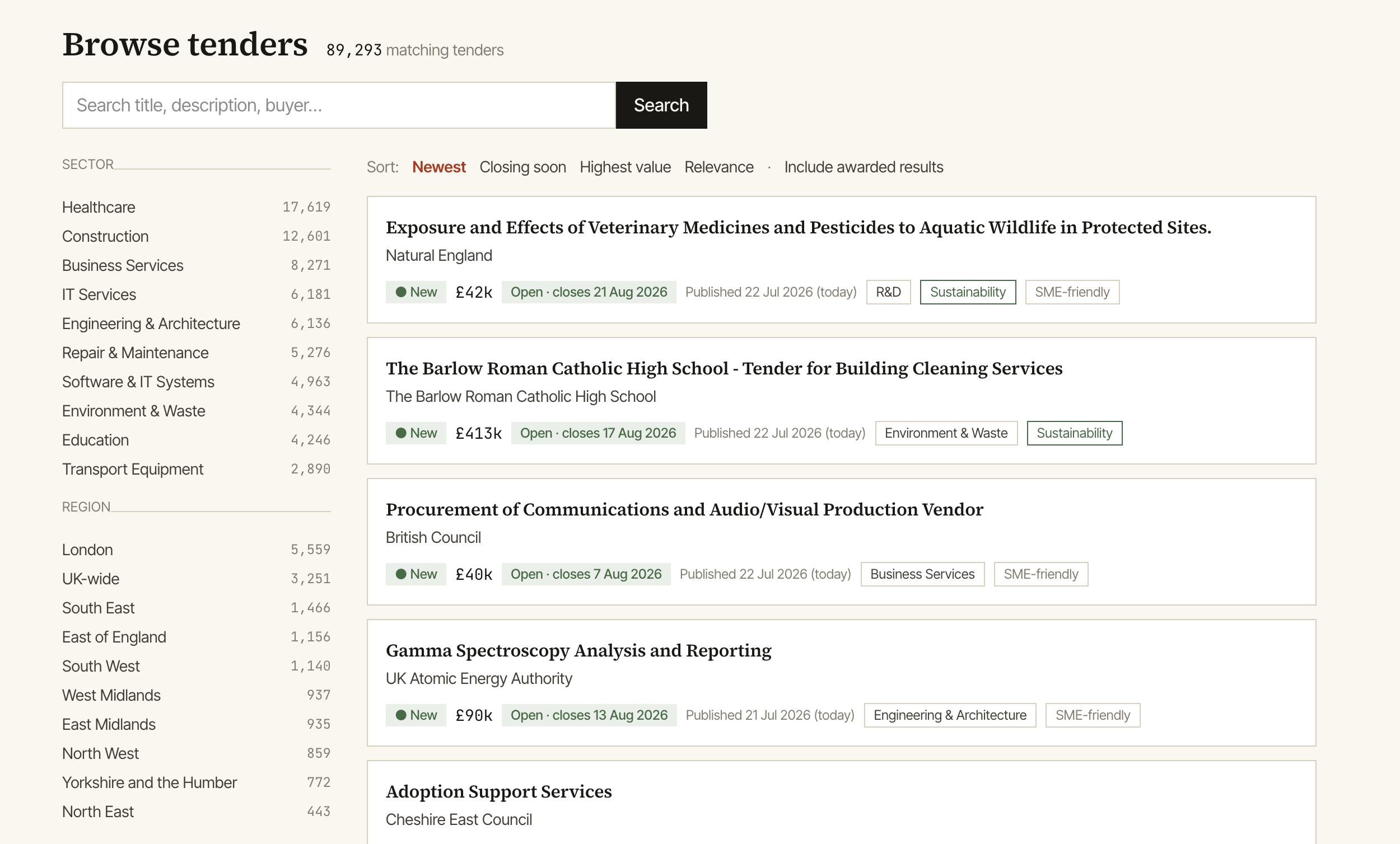
We publish no time-saving multiple and no win-rate uplift for our own product. Every such benchmark we could find in this category is a vendor measuring itself, and we are a vendor in this category. Where an independent measurement exists we will cite it and say whose it is.
Questions people actually ask about RFPs and tenders
These are real search strings from this page's own query data, reproduced as typed.
is rfp and tender the same
Not quite, and the honest answer has two halves. As terms of art they are different methods — an RFP asks you to propose a solution, a tender asks you to bid against a specification, and bodies like UNCITRAL and the World Bank define them separately with different conditions of use. As words used in the UK, they have largely collapsed into one another: “RFP” has no definition in the Procurement Act 2023, and the Government Commercial Agency's own glossary says an RFP “is sometimes known as either Invitation to Tender (ITT), a Request for Quotation (RFQ) or a Request for Tender (RFT)”. So: different in principle, interchangeable in most UK conversations, and legally irrelevant as a label. The comparison is worked through point by point on RFP vs tender.
rfp full form in tender
RFP stands for request for proposal. It is the same three words everywhere the acronym is used. In a UK tender context it usually appears as the title of the document pack a buyer sends out, or as the name of the stage at which you are asked to submit your priced response — but it is the buyer's own word, not a stage defined anywhere in UK procurement law.
what is the difference between a tender and an rfp
How much has already been decided. In a tender the specification is fixed and you compete on compliance, quality and price against published criteria. In an RFP the outcome is fixed but the method is not, and you compete on your approach — which is why RFPs are usually multi-stage and usually allow negotiation, while an open-procedure tender is single-stage and assessed as submitted. In the UK public sector there is a second difference that matters more in practice: a tender carries statutory minimum deadlines, an assessment summary when you lose, an eight-working-day standstill and a right to challenge in the High Court. A private RFP carries none of those.
rfp vs rfq and invitation to tender
Three points on one scale. An RFQ has the tightest specification and competes almost purely on price — UNCITRAL restricts it to readily available goods and services with an established market, below a threshold, with quotations from at least three suppliers. An ITT has a fixed specification but scores quality as well as price; under the Procurement Act 2023 the tender notice itself is the invitation to tender in an open procedure. An RFP has the loosest specification and scores your proposed approach. If you want a one-line test: RFQ asks “how much”, ITT asks “can you do exactly this, and how well”, RFP asks “what would you do”.
what does “open tender” mean
Under the Procurement Act 2023 the open procedure is defined in s.20(2)(a) as “a single-stage tendering procedure without a restriction on who can submit tenders”. Any supplier may respond, there is no pre-qualification gate, and everyone is assessed against the same published criteria. Open procedures were 41% of UK procedures by number in February 2026, up from 27% a year earlier — and 52% of awarded value was tendered openly.
can i negotiate after submitting a tender
Not in an open procedure — it is single-stage and your tender is assessed as submitted. Under a competitive flexible procedure the buyer can design negotiation rounds into the process, and many do; that is the closest UK public procurement gets to an RFP. The hard limit is s.20(4)(c): the procedure cannot admit any supplier that did not tender in the first round or that was excluded in an earlier one. In the private sector, negotiation is normal and usually expected.
is an rfp a contract
No. The RFP is an invitation to make offers; your response is the offer; the contract exists when the buyer accepts it. One nuance worth knowing: in US federal law, responses to an RFP are “proposals” and are offers, but responses to a request for quotation “are ‘quotations’, not offers” and cannot be accepted to form a contract. And in UK public procurement, acceptance is not the end either — the authority must publish a contract award notice, issue assessment summaries and let an eight-working-day standstill run before it can enter the contract.
difference between eoi and rfp
An expression of interest is a low-cost signal, not a bid. The Government Commercial Agency describes an EOI as “a set of high level requirements outlined by the buyer and sent to potential suppliers”, used for market engagement or to build a shortlist — and notes that if you do not respond to one, the buyer need not invite you to tender. An RFP is the substantive stage where you are asked for a costed proposal that can be evaluated and accepted. Under the Procurement Act 2023 the nearest statutory concept to an EOI is a “request to participate” in a competitive flexible procedure.
which of the following methods is commonly used for competitive procurement in government
Competitive tendering — and in UK law specifically, one of exactly two procedures: the open procedure or the competitive flexible procedure, both defined in s.20(2) of the Procurement Act 2023. Internationally, open tendering is the default method in the UNCITRAL Model Law, which says a procuring entity “shall conduct procurement by means of open tendering” unless a stated exception applies, and the WTO Government Procurement Agreement names open, selective and limited tendering as the three permitted methods.
rfp uk — does the term mean anything here?
It means something in practice and nothing in law. UK buyers, particularly in the private sector and in below-threshold public buying, use “RFP” freely; you will find bid packs titled exactly that published on Find a Tender by the authorities that wrote them. But the Procurement Act 2023 does not contain the term, Cabinet Office guidance does not use it, and no obligation attaches to it. If a UK public body sends you an RFP, work out which procedure it is running and read the rules for that.
how do i find rfp and tender opportunities
For UK public sector, Find a Tender is now the central digital platform and carries everything published under the Procurement Act 2023 — above and below threshold. Contracts Finder is still live but now carries mainly legacy notices from procurements commenced under the old regulations. Scotland runs Public Contracts Scotland under its own legislation. For private-sector RFPs there is no register: they arrive through relationships, industry portals and incumbency. Our own search ingests both UK registers, and the forward calendar shows contracts coming up for re-award before the notice appears.
what software helps with organising public tenders professionally?
The category splits into four separable jobs — finding opportunities, deciding what to bid for, extracting the requirements out of the pack, and drafting the response from your own past answers — and very few products are strong at all four. Decide which one is actually failing before you shortlist anything. We compare eleven UK products against eleven published criteria on AI tool for bids and tenders, including a section naming where we come off worst.
RFP and tender glossary
Twenty terms you will meet in a UK procurement document, each with the source that defines it where one exists.
What the UK market actually looks like
Four numbers, each labelled with what it measures — because the widely-quoted figures in this category measure different things and get used interchangeably.
One figure we have removed rather than carried forward: this page previously published “£445B” for UK procurement. It traces to a vendor blog, not to a statistical source, and it is not reproduced. A second, “46% UK RFP win rate”, comes from Loopio's global survey of proposal teams across all sectors — the current edition says 47%, and it is not a UK public-procurement statistic. [35] It appears here only with that label.
Related reading
RFP vs tender, in depth
The comparison on its own, with the private-sector case worked through further.
RFP vs RFQ
Where the line sits between proposing a solution and quoting a price.
RFI vs RFP
Market engagement versus the substantive ask, and why answering an RFI badly costs you the RFP.
RFP meaning
The term on its own — full form, origin, and how it is used across sectors.
RFP procurement
The buyer's vocabulary rather than the statute's: where an RFP sits in a procurement cycle.
RFP in the UK
What the acronym does and does not carry here, above and below threshold.
Find a Tender, ingested
The central digital platform as a feed: what we take from it and how often.
How to win a tender
After the differences: qualifying out early, and where the marks actually are.
The tender process
Every stage from notice to award, in the order it happens.
Procurement Act 2023
The statute itself: what changed on 24 February 2025 and what it means for suppliers.
ITT response software
Answering the invitation to tender specifically, with compliance as a gate.
How to write a tender response
Writing to published criteria, in the criteria's order and vocabulary.
AI tool for bids and tenders
Eleven criteria, eleven UK products, weighted by you — including where we lose.
Contracts Finder and Find a Tender
The two registers, what each now carries, and how to watch both.
Search live tenders
The corpus itself — every notice we ingest, above and below threshold.
Your real odds
Both retention measures per category, with the rule that produced each classification.
Sources
- Procurement Act 2023 (c. 54), legislation.gov.uk. Sections cited individually below; ss.15, 17, 21, 41, 44, 50, 51, 53, 54, 75, 80, 87, 93 and 95 are each at
/ukpga/2023/54/section/<n>. Accessed 15 August 2026. - Procurement Act 2023, s.56 — Technical specifications. The Act's only provision containing the word “proposal”, in the phrase “tenders, proposals or applications”.
- Procurement Act 2023, s.20 — Competitive tendering procedures. s.20(2) defines the open and competitive flexible procedures; s.20(3) the proportionality duty; s.20(4)(c) the bar on late entrants.
- Procurement Act 2023, s.41 — Direct award in special cases, and Schedule 5 — Direct award justifications.
- Procurement Act 2023, s.19 — Award of public contracts following a competitive tendering procedure. The “most advantageous tender” test.
- Procurement Act 2023, s.54 — Time limits. The participation-period table at s.54(3) and the tendering-period table at s.54(4). “Qualifying planned procurement notice” is defined at s.15(3).
- Procurement Act 2023, s.51 — Standstill periods on the award of contracts. Eight working days; exemptions at s.51(3).
- Procurement Act 2023, s.50 — Contract award notices and assessment summaries.
- Procurement Act 2023, s.22 — Conditions of participation.
- Procurement Act 2023, s.16 — Preliminary market engagement and s.17 — Preliminary market engagement notices. Cabinet Office, Guidance: Preliminary Market Engagement, which does not use the term “RFI”.
- Procurement Act 2023, s.87 — Regulated below-threshold contracts: duty to publish notices, and Cabinet Office, Guidance: Below-Threshold Contracts.
- Procurement Act 2023, s.95 — Publication of information. s.95(4) requires the online system that is the central digital platform.
- Procurement Act 2023, Schedule 11 — revoking the Defence and Security Public Contracts Regulations 2011, the Public Contracts Regulations 2015, the Concession Contracts Regulations 2016 and the Utilities Contracts Regulations 2016.
- The Procurement Act 2023 (Commencement No. 3 and Transitional and Saving Provisions) (Amendment) Regulations 2024, SI 2024/959 — moving go-live from 28 October 2024 to 24 February 2025.
- Cabinet Office, PPN 023: 2026 Threshold Amounts, and The Procurement Act 2023 (Threshold Amounts) (Amendment) Regulations 2025, SI 2025/1200, in force 1 January 2026. Figures include VAT.
- Cabinet Office, Guidance: Competitive Tendering Procedures — “in the case of the open procedure, the tender notice is the ‘invitation to tender’”, and the definition of a request to participate.
- Cabinet Office, Guidance: Conditions of Participation (PDF) — the Act “does not prescribe how suppliers should demonstrate that they meet the conditions of participation”.
- Cabinet Office, Procurement Policy Notes collection, where PPN 03/24 (Standard Selection Questionnaire) is listed under “Public Contract Regulations 2015 PPNs”, applying only to procurements commenced before 24 February 2025. Lineage: PPN 08/16 retired the PQQ in 2016.
- Government Commercial Agency, procurement glossary — entries for Request for Proposal, Invitation to Tender, Request for Information, Expression of Interest, RFx and Tender submissions. GCA is the body Crown Commercial Service became on 1 April 2026. Accessed 15 August 2026.
- UNCITRAL, Model Law on Public Procurement (2011) (PDF) — Article 2 definitions of “submission”, “solicitation” and “solicitation document”; Article 27 methods; Article 28 default of open tendering; Article 29(2) and 46 on requests for quotations; Article 36 invitation to tender; Article 47 requests for proposals.
- World Bank, Procurement Regulations for IPF Borrowers — paragraphs 6.2 to 6.7, defining Request for Proposals, Request for Bids and Request for Quotations as separate selection methods.
- World Trade Organization, Agreement on Government Procurement as amended by the 2012 Protocol — Article I definitions of open, selective and limited tendering; Article IV:4.
- US Federal Acquisition Regulation, FAR 15.203 — Requests for proposals.
- US Federal Acquisition Regulation, FAR 2.101 — Definitions, on “offer”, bids, proposals and quotations; and Department for Business and Trade, Navigating NATO procurement, which uses “Invitation for Bid (IFB)” without defining it.
- US Federal Acquisition Regulation, FAR 13.004 — Legal effect of quotations.
- Directive 2014/24/EU on public procurement — Article 2 definitions of “tenderer” and “candidate”, Article 26 procedures, Article 27 open procedure.
- Gavin Hayman and Camila Salazar, The UK Procurement Act one year on: what does the data tell us?, Open Contracting Partnership, 3 March 2026. Analysis of Find a Tender OCDS releases, 24 February 2025 to 28 February 2026, described by its authors as a “best efforts” analysis with variable underlying data quality.
- House of Commons Library, Public procurement statistics (CBP-9317), drawing on HM Treasury's Public Expenditure Statistical Analyses 2026 and Whole of Government Accounts.
- British Chambers of Commerce and Tussell, SME Procurement Tracker 2026. Direct spend only.
- Procurement Act 2023, Part 9 — Remedies: s.100 duties enforceable in civil proceedings, s.101 automatic suspension, s.102 interim remedies, ss.103–105 pre- and post-contractual remedies and set-aside conditions, s.106 time limits.
- Cabinet Office, Procurement Compliance and Oversight — the Public Procurement Review Service and the Procurement Compliance Service; and Debarment Review Service, which transferred to the Government Commercial Agency on 1 April 2026 when the Procurement Review Unit ceased to exist as a business unit.
- Cabinet Office, National Procurement Policy Statement, published 12 February 2025, in effect from 24 February 2025.
- Cabinet Office, Central Digital Platform factsheet, and Find a Tender: notice types.
- Cabinet Office, PPN 019: Requirements to publish on Contracts Finder — “any new below threshold opportunities must be advertised on Find a Tender in accordance with the Procurement Act.”
- Loopio, RFP statistics and win rates. A global survey of 1,500+ proposal teams across all sectors, self-reported; not a UK public-procurement statistic and not independent of the vendor publishing it.
- The Procurement Regulations 2024 (SI 2024/692), reg. 5 — Publication of notices etc on central digital platform. Reg. 5(1) requires publication “on the central digital platform”; reg. 5(3) lists the provisions caught, including s.15(1), s.17(1)(a) and s.21(1). Accessed 17 August 2026.
- The Public Contracts (Scotland) Regulations 2015 (SSI 2015/446), reg. 27 — Choice of procedures. Scotland did not adopt the Procurement Act 2023; reg. 27(3) permits “an open or a restricted procedure; or an innovation partnership”, with the call for competition made by contract notice or prior information notice. Accessed 17 August 2026.
Corrections policy: where a figure on this page turns out to be wrong we append the correction and say what was believed before, rather than editing the mistake away. Two such corrections are already recorded above — the £445bn procurement figure and the Contracts Finder below-threshold claim, both carried by the previous version of this page.